No. 02 · Optimization Research · Cancer Care Delivery
The clock starts when the doctor decides
Cell therapy cut manufacturing to seven days. The wait a patient actually experiences did not shrink with it, because most of that wait was never manufacturing. In January 2027 the largest segment anyone has put a deadline on becomes an API — and almost no one in oncology is instrumented to use it.
Applied research · evidence-based systems analysis · September 2, 2026 · 15 min
One-page PDF ↓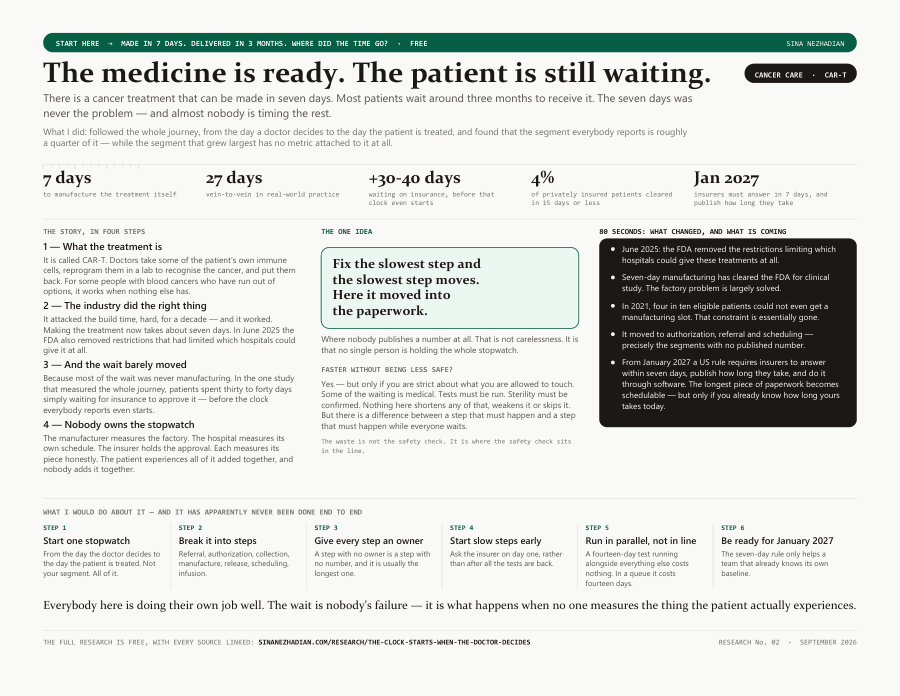
Free handout2 pages · PDF
The medicine is ready. The patient is still waiting.
The whole study in plain words, written for a room with no background assumed. Page one is where the wait actually goes and what would fix it — share it on screen or print it. Page two is a 90-second script you can read out loud.
Open the PDF →- 7 days
- to manufacture the therapy
- 27 days
- vein-to-vein in real-world practice
- +30–40
- days of authorization before that clock starts
- 4%
- privately insured cleared in 15 days or less
Short version · no jargon
The medicine is ready. The patient is still waiting.
The whole idea in five questions — why I looked, what I found, and what would fix it.
In brief
- The problem
- CAR-T cures patients who had run out of options. Getting it to them takes months, and a measurable share of them die or become too sick during the wait. The industry has spent a decade compressing the manufacturing step — which, in the published data, is about a quarter of vein-to-vein time and a much smaller share of the full wait.
- Why now
- The manufacturing constraint has largely been relieved: capacity expanded, the FDA removed REMS in June 2025, and seven-day vein-to-vein manufacturing has cleared the FDA for clinical study. The constraint did not disappear. It moved to authorization, referral, and scheduling — where no one measures it end to end.
- The gap
- Every party measures the segment it owns. Manufacturers report vein-to-vein. Centers track their own scheduling. Payers hold authorization. No one owns the clock the patient actually experiences, so the segment that grew largest is the one with no metric attached to it.
- The proposal
- One clock, decision to dose, decomposed into named segments with named owners; the safety gates moved off the critical path rather than shortened; and authorization treated as a schedulable step ahead of the January 2027 rule that makes it one.
- What success looks like
- Not a faster factory. A shorter interval between the day a physician decides and the day the patient is treated — achieved without touching a single release criterion, because none of the waste identified here is clinical.
There is a version of this story where the science is the hard part. It is not. The therapy works, the manufacturing is fast, and the regulators have been actively removing barriers. And yet in the one published cohort that measured the whole interval, the median patient waited roughly three months between the request for insurance approval and the infusion. Building the therapy accounts for about a week of that. Nobody publishes a number for the rest.
12 sections
CAR-T therapy takes a patient’s own T cells, reprograms them to recognise their cancer, and puts them back. For some people with relapsed blood cancers it is the difference between months and years. The catch has always been that it has to be built, per patient, before it can be given.
So the field has spent a decade attacking manufacturing time — and it has worked. Kite reports a median manufacturing time of seven days from the start of cell enrichment to harvest.2 Galapagos has taken a decentralised, fresh CAR-T product through FDA clearance for US clinical study at a median seven-day vein-to-vein time.6 In vivo approaches now entering the clinic aim to skip the manufacturing step altogether.7
Meanwhile, the wait a patient experiences has not moved anything like as far.
Start with the segment the industry does measure. In a CIBMTR analysis of 1,383 patients across 78 US centres, the real-world median vein-to-vein time — leukapheresis to infusion — was 27 days. Kite’s own turnaround from leukapheresis to product release was 16 days, of which manufacturing was seven.2
So even inside the segment the manufacturer controls, manufacturing is roughly a quarter of the elapsed time. The rest is transport, release testing, and the scheduling of a patient who must be admitted, lymphodepleted, and ready on the day the cells arrive.
That analysis also found something worth pausing on. Complete response rates were 60% under 28 days and 61% between 28 and 39 days — then 50% at 40 days or more. Two-year overall survival was 53% for patients treated within 39 days and 38% beyond it, adjusted for prognostic factors.2 The clock is not administrative trivia. Past a threshold, it shows up in survival.
Now the segment nobody reports. A 2025 study from the University of Chicago followed 64 consecutive insured myeloma patients and measured what it called brain-to-vein time: from the day the insurance approval request is submitted to the day cells are collected — before the vein-to-vein clock starts at all.
| Segment | Medicare | Private insurance |
|---|---|---|
| Brain-to-vein (approval request → cell collection) | 29.5 days | 39.5 days |
| Vein-to-vein (collection → infusion) | 62 days | 59 days |
| Patients achieving brain-to-vein ≤ 15 days | 23% | 4% |
A month to forty days passes before the measured clock begins. Privately insured patients waited longest, because every one of them required a single case agreement — a bespoke contract negotiated per patient, per centre. Only one privately insured patient in twenty-four cleared authorization within fifteen days.1
And the authors note this: all five patients who died before receiving CAR-T had a brain-to-vein time over 15 days.
It would be easy, and wrong, to read this as the field having optimised the wrong thing. In 2021 manufacturing capacity genuinely was the binding constraint, and the consequences were severe.
A study of 40 myeloma patients eligible for BCMA CAR-T at a US centre found that only 60% secured a manufacturing slot; the centre was allocated a median of two slots per month. Median time from consultation to collection was 38 days, with a range running to 703. Six-month survival was 92% among patients who received CAR-T and 56% among those who did not.3
So the field attacked the constraint it could see, and it moved it. Capacity expanded. Turnaround shortened. On 26 June 2025 the FDA eliminated the REMS programmes for six approved CAR-T products, cut the post-infusion proximity requirement to two weeks, shortened the driving restriction to two weeks, and dropped the requirement that dispensing hospitals be specially certified with on-site, immediate access to tocilizumab.4 That was a direct, deliberate widening of who can deliver these therapies and where.
This is what good optimisation looks like. It is also what always happens next.
Relieve the binding constraint in any system and it does not vanish — it relocates to whatever is now the slowest step. Anyone who has run a factory, a fleet, or a delivery programme has watched this happen. The failure mode is not the relocation. It is not noticing.
The evidence that it moved is in the shape of the data. Manufacturing is seven days and falling toward one. Authorization is thirty to forty days and, in the one study that measured it, was worse for the better-insured patients — because the payment mechanism, not the biology, was the obstacle.1
A July 2026 review of the field lists what still stands between patients and these therapies: referral pathways, reimbursement complexity, site-of-care restrictions, and disparities in geographic availability — alongside manufacturing timelines, not instead of them.8 Only one of those five appears in any vein-to-vein figure.
The reason is structural, not negligent. Each party measures the segment it owns, and the segments are owned by different organisations with different incentives.
- The manufacturer measures vein-to-vein, because that is the interval it controls and can be held to. It is a genuine performance metric, and it is reported well.
- The treatment centre measures its own scheduling, apheresis capacity, and bed availability — usually inside a hospital operations system that never speaks to the manufacturer’s.
- The payer holds authorization, and until now has had no obligation to report how long it takes.
- The patient experiences the sum, which is the only number that matters clinically, and which nobody computes.
“The brain-to-vein time should supersede the vein-to-vein time as a better indicator of the success… This period is unaccounted for in clinical trials, and it is difficult to assess in real-world analyses.”
That was written in 2022. Four years on, the segment he named is still the one without a number.
Every optimisation proposal in medicine has to answer one question first: what does it cost in safety? Here the answer is unusually clean, and it is the reason this is worth doing.
The waiting described above is almost entirely non-clinical. Sterility testing, potency and identity release criteria, eligibility confirmation, lymphodepletion timing, toxicity monitoring — these are clinical steps with clinical justification, and nothing here proposes shortening any of them.
What it proposes is the oldest idea in process engineering: a step that must happen is not the same as a step that must happen in series. A fourteen-day sterility test on the critical path is a fourteen-day delay. The same test, started earlier and run in parallel against a product that is already moving, is a safeguard that costs nothing in time. The inspection is not the waste. Its position in the sequence is.
The one non-clinical segment large enough to matter is about to acquire a deadline, a public metric, and an interface — all from the same regulation.
The CMS Interoperability and Prior Authorization Final Rule (CMS-0057-F) requires affected payers to decide standard prior authorization requests within seven calendar days and urgent requests within 72 hours; to publicly post their approval rates and average turnaround times; and, from 1 January 2027, to expose prior authorization through a FHIR-based API.9
Read that as an operations person rather than a compliance one. A step that took thirty to forty days becomes bounded at seven. A step that was invisible becomes publicly reported. And a step that was a fax-and-phone negotiation becomes a system call — which means it can be triggered early, tracked, retried, and scheduled around.
The proposal is a measurement discipline first and a scheduling system second, because the second is worthless without the first. None of it requires new science, new regulation, or a new vendor category.
1. One clock, named segments, named owners. Define decision-to-dose as the primary operational metric: the interval from the documented decision to treat, to first infusion. Decompose it into segments — referral, workup, authorization, apheresis scheduling, manufacturing, release, admission, lymphodepletion, infusion — and assign each a single accountable owner. This is a value-stream map, and it is the same instrument used to shorten any industrial process. It has simply never been pointed at this one end to end.
2. Separate touch time from wait time. For each segment, record both how long the work takes and how long the patient waits. In every process that has ever been mapped this way, the ratio is the finding. Seven days of manufacturing inside a ninety-day journey is a touch-time-to-lead-time ratio that would trigger an immediate investigation in any factory.
3. Start the slow step first. Authorization is the longest segment and the one least dependent on clinical workup being complete. Submitting it at the decision point rather than after staging — and pre-booking the apheresis slot and the infusion bed against a provisional date — converts a serial chain into overlapping ones. This is not a novel idea; it is how every complex programme with a long-lead item is run.
4. Build for the API before it arrives. Organisations that have instrumented their authorization segment will be able to act on the January 2027 interface on day one. Organisations that have not will spend that year discovering what their baseline was.
It would be convenient to claim this is an AI problem. It mostly is not, and saying so is the more useful position.
The core of it is measurement, ownership, and sequencing — classical operations work that predates machine learning by fifty years. AI earns its place at three specific points, all of them narrow and all of them already technically solved elsewhere.
- Assembling the authorization packet. Extracting the required clinical evidence from the record, pre-populating the submission, and flagging what is missing before it is sent. This is document work, it is high-volume, and it is where most avoidable resubmission comes from.
- Predicting which requests will be denied, so that the appeal or the single case agreement negotiation starts in parallel rather than after the denial arrives.
- Finding eligible patients earlier in the record. The interval before a referral is even made is not in any dataset here, and is plausibly the largest segment of all.
None of those require a frontier model, and none of them touch a clinical decision. The honest framing is that AI shaves days off two administrative segments; a value-stream map and an owner shave weeks off the whole line.
I have not run this. What follows is the study I would run, designed to be cheap, observational first, and to fail fast if the premise is wrong.
- 1.Baseline, retrospective. At one treatment centre, reconstruct decision-to-dose for every cell-therapy patient over 24 months from existing records: decision date, authorization submitted, authorization granted, apheresis, release, infusion. No new data collection — these timestamps already exist in separate systems. Output: the centre’s own segment distribution.
- 2.Test the premise. If manufacturing turns out to be the largest segment for this centre, stop. The argument does not apply here and that is a useful, publishable result.
- 3.Intervene on sequencing only. Submit authorization at the decision point rather than post-workup; provisionally book apheresis and infusion slots at submission. Nothing clinical changes. Compare against the retrospective baseline and, where possible, a matched concurrent cohort.
- 4.Read out. Primary: median and 90th-percentile decision-to-dose. Secondary: proportion of patients exceeding the 40-day vein-to-vein threshold associated with worse survival in the CIBMTR data.2 Guardrails: no change in release criteria, no increase in cancelled apheresis, no increase in slot wastage from provisional bookings that do not proceed.
The pattern in this study is the same one in my work on AI inference: a system optimises the segment it can see, the constraint moves to a segment nobody measures, and the headline metric keeps improving while the outcome does not.
In agent infrastructure, that looks like a 95.7% cache hit rate coexisting with five times more prefill work than necessary, because the expensive interval belongs to no one. Here it looks like a seven-day manufacturing process inside a ninety-day wait, for the same structural reason.
The technical content is entirely different. The failure is identical, and so is the fix: measure the whole line, name an owner for every segment, and put the constraint where someone can see it.
The science here is not the bottleneck, and has not been for some time. A therapy that can be built in seven days is reaching patients in two to three months, and the largest identified block of that interval is spent waiting for a payment decision that a rule now requires to take seven days.
None of what is described here requires shortening a single safety check. It requires knowing where the time goes — which, remarkably, no published dataset currently does end to end.
That is not a research problem. It is a measurement problem with a mortality signal attached, and those are usually the ones worth taking seriously first.
Method & disclosure
This is a literature-and-documentation study. No benchmark was run and no experiment was performed. Every measured figure is attributed to the source that produced it; every derived figure comes from a model published alongside this piece, whose inputs, assumptions and limitations are stated in its source. Where a source is a vendor publishing its own results, it is labelled as such. Where the evidence is confounded or the sample is small, the text says so rather than rounding it away.
Sources
- 01Brain-to-vein and vein-to-vein times and outcomes in CAR T-cell therapy in myeloma
Tyra K. Grischke, Jordan H. Cooperrider, Ammar Pula, Adam Sneider, Sarah Yates, Andrzej J. Jakubowiak, Benjamin A. Derman · Blood Cancer Journal 15:47 · University of Chicago · March 28, 2025
Paper
64 consecutive insured patients at one academic centre. The authors state that in multivariate analysis neither insurance type, brain-to-vein, nor vein-to-vein time was significantly associated with outcomes; the mortality pattern noted here is descriptive.
- 02Time to CAR T-cell Therapy May Impact Outcomes for Patients With Relapsed/Refractory Large B-cell Lymphoma in New CIBMTR Analysis
Kite (Gilead) · CIBMTR real-world analysis, 1,383 patients across 78 US centres · December 2022
Vendor
Manufacturer-issued release reporting a registry analysis of its own product. The registry data are independent; the framing is not. Patient data span 2017–2020.
- 03“Waitlist mortality” is high for myeloma patients with limited access to BCMA therapy
Nausheen Ahmed, William Wesson, Muhammad Umair Mushtaq, Rajat Bansal, Leyla Shune, et al. · Frontiers in Oncology · August 3, 2023
Paper
40 eligible patients, single centre, data from 2021 when slot scarcity was at its worst. Survival differences between those who did and did not receive CAR-T are confounded by disease severity and are not a clean estimate of the cost of delay.
- 04FDA Eliminates Risk Evaluation and Mitigation Strategies (REMS) for Autologous CAR T cell Immunotherapies
U.S. Food and Drug Administration · June 26, 2025
Documentation
- 05Autologous and Allogeneic CAR T-Cell Therapies: Spotlighting the “Brain-to-Vein” Time
Matthew A. Lunning, DO · Clinical Advances in Hematology & Oncology · March 2022
Paper
- 06Galapagos announces FDA clearance of IND application for Phase 1/2 ATALANTA-1 study of CD19 CAR-T, GLPG5101
Galapagos NV · August 2024
Vendor
Sponsor announcement for an investigational product with a median seven-day vein-to-vein time. Not approved. Cited as evidence that the manufacturing segment is compressible, not as an available treatment option.
- 07
- 08CAR T-Cell Therapy in 2026 and Beyond: Evolving Evidence, Expanding Indications, and the Path to Broader Access
The American Journal of Managed Care · July 13, 2026
Engineering
- 09CMS Interoperability and Prior Authorization Final Rule (CMS-0057-F)
Centers for Medicare & Medicaid Services · Final rule January 2024; requirements phase in 2026–2027
Documentation